
Merge Engine
相同主键的多条数据,Paimon会根据merge-engine参数对数据进行合并
Deduplicate
'merge-engine' = 'deduplicate' -- deduplicate 是默认值,可以不设置对于多条相同主键的数据,主键表仅会保留最新一条数据。如果最新数据是delete操作,所有对应主键的数据都会被丢弃。
Deduplicate 案例
SET 'execution.runtime-mode' = 'streaming';
SET 'table.exec.sink.upsert-materialize'='NONE';
SET 'execution.checkpointing.interval'='10 s';
set parallelism.default=1;
SET 'sql-client.execution.result-mode' = 'tableau';
CREATE CATALOG paimon WITH (
    'type' = 'paimon',
    'warehouse' = 'hdfs://mj01:8020/lakehouse'
    );
USE CATALOG paimon;
create database if not exists merge_test;
CREATE TABLE if not exists paimon.merge_test.deduplicate_test1(
 `id` Int,
  `name` String,
  `salary` Int,
   PRIMARY KEY (id) NOT ENFORCED
) with  (
'merge-engine' = 'deduplicate'
);

CREATE TABLE if not exists paimon.merge_test.deduplicate_test2(
 `id` Int,
  `name` String,
  `salary` Int,
   PRIMARY KEY (id) NOT ENFORCED
);

insert into paimon.merge_test.deduplicate_test2 select * from paimon.merge_test.deduplicate_test1;

insert into paimon.merge_test.deduplicate_test1 values(1,'flink',1000);
insert into paimon.merge_test.deduplicate_test1 values(1,'flink',2000);
insert into paimon.merge_test.deduplicate_test1 values(1,'flink',500);
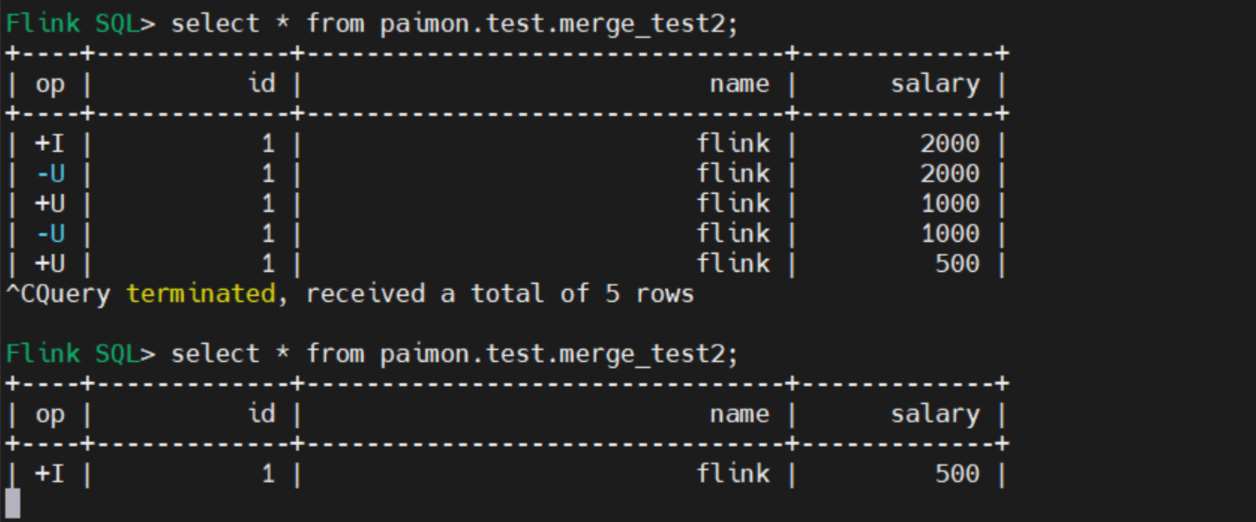
结果只有最新的一条数据

First-row
'merge-engine' = 'first-row'Paimon只会保留相同主键数据中的第一条。与deduplicate合并机制相比,first-row只会产生insert类型的变更数据。
重点注意:
- 下游如果需要流式消费first-row的产生的数据,上游表changelog-producer参数必须设置为 lookup。
- first-row无法处理delete与update_before消息。您可以设置'first-row.ignore-delete' = 'true'以忽略这两类消息。
- first-row不支持changelog-producer input、full-compaction模式
为什么frist-row不支持input、full-compaction模式?
- full-compaction:每一次执行小文件全量合并(full compaction)时,产生完整的变更数据。
- input:直接将输入的消息作为变更数据传递给下游消费者(作为changelog) input、full-compaction严格意义上与first-row相违背。所以first-row支持none、lookup
First-row 案例
SET 'execution.runtime-mode' = 'streaming';
SET 'table.exec.sink.upsert-materialize'='NONE';
SET 'execution.checkpointing.interval'='10 s';
set parallelism.default=1;
SET 'sql-client.execution.result-mode' = 'tableau';
CREATE CATALOG paimon WITH (
    'type' = 'paimon',
    'warehouse' = 'hdfs://bigdata01:8020/lakehouse'
    );
USE CATALOG paimon;
create database if not exists merge_test;


CREATE TABLE if not exists paimon.merge_test.first_test2(
 `id` Int,
  `name` String,
  `salary` Int,
   PRIMARY KEY (id) NOT ENFORCED
);

CREATE TABLE if not exists paimon.merge_test.first_test1(
 `id` Int,
  `name` String,
  `salary` Int,
   PRIMARY KEY (id) NOT ENFORCED
) with  (
'merge-engine' = 'first-row',
'changelog-producer'='lookup' --none、input、lookup、full-compaction
 );


insert into paimon.merge_test.first_test2 select * from paimon.merge_test.first_test1;

insert into paimon.merge_test.first_test1 values(1,'flink',1000);
insert into paimon.merge_test.first_test1 values(1,'flink',2000);


SELECT * FROM paimon.merge_test.first_test1 /*+ OPTIONS('scan.snapshot-id' = '1') */
当merge-engine为first-row的时候,不是所有的changelog producer类型都支持。只有none和lookup类型支持,其他都报错。
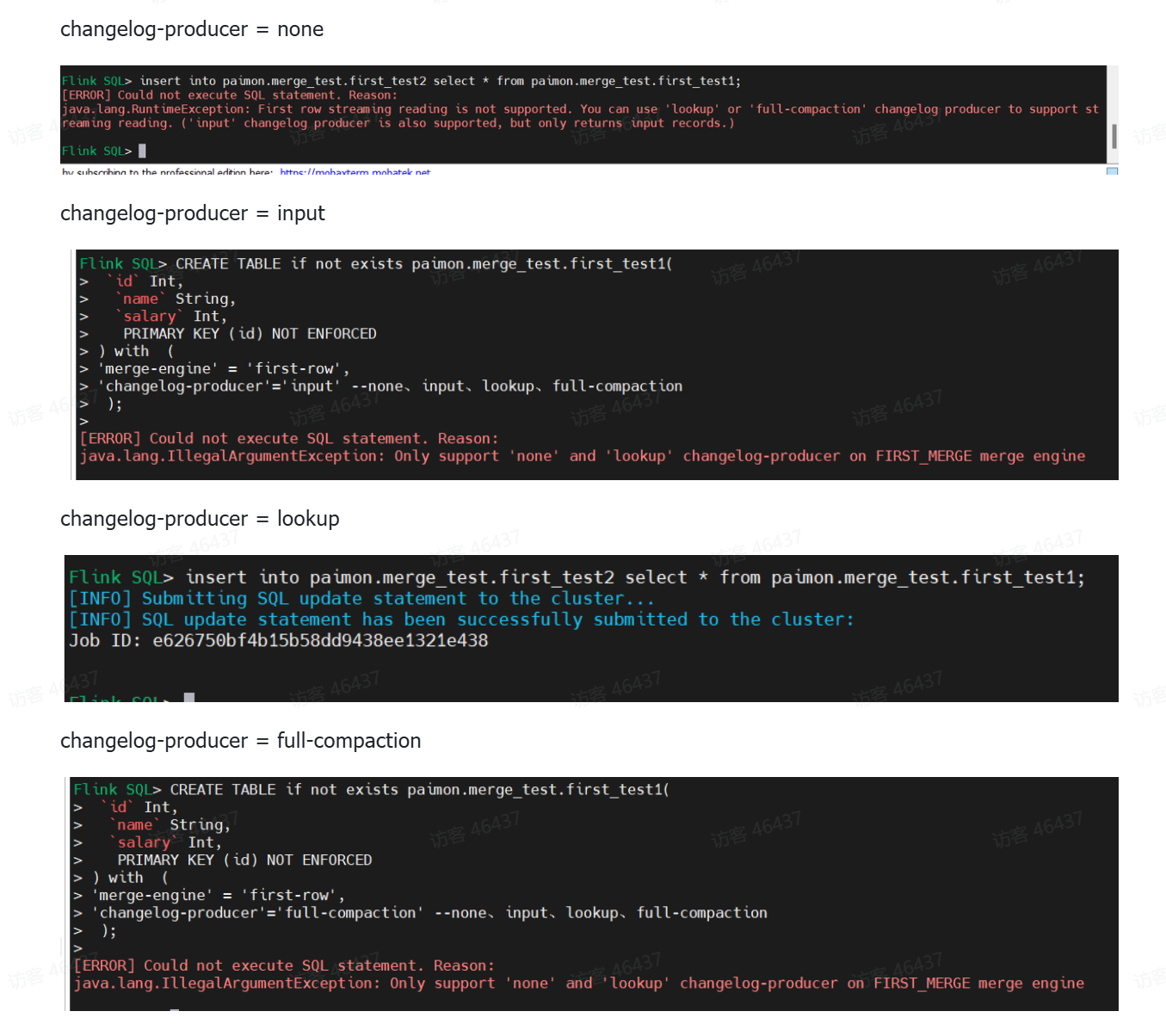
但在流读模式下,none不产生changelog,因此也只能将changelog producer设置为lookup.
结果只有第一条数据
Aggregate
具有相同主键的多条数据,主键表将会根据指定的聚合函数进行聚合。对于不属于主键的每一列,都需要通过fields.{field-name}.aggregate-function指定一个聚合函数,否则该列将默认使用last_non_null_value聚合函数。
支持的聚合函数与对应的数据类型如下:
- sum(求和):支持DECIMAL、TINYINT、SMALLINT、INTEGER、BIGINT、FLOAT和DOUBLE。
- product(求乘积):支持DECIMAL、TINYINT、SMALLINT、INTEGER、BIGINT、FLOAT和DOUBLE。
- count(统计非null值总数):支持INTEGER和BIGINT。
- max(最大值)和min(最小值):CHAR、VARCHAR、DECIMAL、TINYINT、SMALLINT、INTEGER、BIGINT、FLOAT、DOUBLE、DATE、TIME、TIMESTAMP和TIMESTAMP_LTZ。
- first_value(返回第一次输入的值)和last_value(返回最新输入的值):支持所有数据类型,包括null。
- first_not_null_value(返回第一次输入的非null值)和last_non_null_value(返回最新输入的非 null 值):支持所有数据类型。
- listagg(将输入的字符串依次用英文逗号连接):支持STRING。
- bool_and和bool_or:支持BOOLEAN。
如果下游需要流式消费aggregation的结果,需要将changelog-producer参数设为input、lookup或full-compaction。
Aggregate 案例
SET 'execution.runtime-mode' = 'streaming';
SET 'table.exec.sink.upsert-materialize'='NONE';
SET 'execution.checkpointing.interval'='10 s';
set parallelism.default=1;
SET 'sql-client.execution.result-mode' = 'tableau';
CREATE CATALOG paimon WITH (
    'type' = 'paimon',
    'warehouse' = 'hdfs://bigdata01:8020/lakehouse'
    );
USE CATALOG paimon;
create database if not exists merge_test;


CREATE TABLE if not exists paimon.merge_test.aggregation_test2(
 `id` Int,
  `name` String,
  `salary` Int,
  `sum_cnt` Int,
   PRIMARY KEY (id) NOT ENFORCED
);

CREATE TABLE if not exists paimon.merge_test.aggregation_test1(
 `id` Int,
  `name` String,
  `salary` Int,
  `sum_cnt` Int,
   PRIMARY KEY (id) NOT ENFORCED
)  with  (
  'merge-engine' = 'aggregation',
  'fields.salary.aggregate-function' = 'max',
  'fields.sum_cnt.aggregate-function' = 'sum',
   'changelog-producer' = 'lookup'
);


insert into paimon.merge_test.aggregation_test2
select * from paimon.merge_test.aggregation_test1;

insert into paimon.merge_test.aggregation_test1 values(2,'flink',1000,1000);
insert into paimon.merge_test.aggregation_test1 values(2,'flink',2000,500);
insert into paimon.merge_test.aggregation_test1  values(3,'flink',500,500);

SELECT * FROM paimon.merge_test.aggregation_test1 /*+ OPTIONS('scan.snapshot-id' = '1') */
aggregation不支持none类型的changelog producer,其他类型都支持。 
结果是 salary取最大值2000, sum_cnt求和值2000
Partial-update
'merge-engine' = 'partial-update'设置'merge-engine' = 'partial-update'后,您可以通过多条消息对数据进行逐步更新,并最终得到完整的数据。即具有相同主键的新数据将会覆盖原来的数据,但值为null的列不会进行覆盖。
Sequence Group 序列组
序列字段可能无法解决具有多个流更新的 partial-update 表的无序问题,在多流更新期间,sequence-field 可能会被另一个流的最新数据覆盖。通过设置Sequence Group为不同列分别指定合并顺序
重点注意:
- 如果下游需要流式消费partial-update的结果,changelog-producer参数设为input、lookup或full-compaction。
- partial-update 无法处理 delete 与 update_before 消息。需要设置'partial-update.ignore-delete' = 'true' 以忽略这两类消息。
部分更新效率部分场景下取代left join等链表(shuffle) select id,a,null from streaming1 union all select id,null,b from streaming2
Partial-update 案例1
SET 'execution.runtime-mode' = 'streaming';
SET 'table.exec.sink.upsert-materialize'='NONE';
--设置检查点的间隔为1分钟
SET 'execution.checkpointing.interval'='10 s';
set parallelism.default=1;
SET 'sql-client.execution.result-mode' = 'tableau';
CREATE CATALOG paimon WITH (
    'type' = 'paimon',
    'warehouse' = 'hdfs://bigdata01:8020/lakehouse'
    );
USE CATALOG paimon;
create database if not exists merge_test;
CREATE TABLE if not exists paimon.merge_test.part1(
 `id` Int,
  `name` String,
  `salary` BIGINT,
   PRIMARY KEY (id) NOT ENFORCED
) with  (
'merge-engine' = 'partial-update',
   'changelog-producer' = 'lookup'
);

insert into paimon.merge_test.part1 values(1,'flink',CAST(NULL AS INT));
insert into paimon.merge_test.part1 values(1,cast(NULL as STRING),2000);

CREATE TABLE if not exists paimon.merge_test.part1(
 `id` Int,
  `name1` String,
   `name2` String,
    `name3` String,
  `salary1` BIGINT,
   `salary2` BIGINT,
  `salary3` BIGINT,
   PRIMARY KEY (id,name1,salary1) NOT ENFORCED
) with  (
'merge-engine' = 'partial-update',
   'changelog-producer' = 'lookup'
);
分别插入两次同一主键数据的不同field,最终两次的更新都会到同一条数据上。

Partial-update 案例2 (sequence group)
SET 'execution.runtime-mode' = 'streaming';
SET 'table.exec.sink.upsert-materialize'='NONE';
--设置检查点的间隔为1分钟
SET 'execution.checkpointing.interval'='10 s';
set parallelism.default=1;
SET 'sql-client.execution.result-mode' = 'tableau';
CREATE CATALOG paimon WITH (
    'type' = 'paimon',
    'warehouse' = 'hdfs://bigdata01:8020/lakehouse'
    );
USE CATALOG paimon;
create database if not exists merge_test;
CREATE TABLE if not exists paimon.merge_test.part2(
 `id` Int,
  `name` String,
   `sg_1` Int,
  `salary` BIGINT,
   `sg_2` Int,
   PRIMARY KEY (id) NOT ENFORCED
) with  (
'merge-engine' = 'partial-update',
'changelog-producer' = 'input',
'fields.sg_1.sequence-group' = 'name',
'fields.sg_2.sequence-group' = 'salary'
);

insert into paimon.merge_test.part2 values(1,'flink',1,1,1);
--    output: +I | 1 | flink | 1 | 1 | 1
insert into paimon.merge_test.part2 values(1,'flink1',0,1,cast(NULL as Int));
--    output: +I | 1 | flink | 1 | 1 | 1
insert into paimon.merge_test.part2 values(1,'flink2',1,2000,1);
--    output: +I | 1 | flink2 | 1 | 2000 | 1
insert into paimon.merge_test.part2 values(1,'flink3',0,3000,0);
--    output: +I | 1 | flink2 | 1 | 2000 | 1
insert into paimon.merge_test.part2 values(1,'flink3',2,3000,2);
--    output: +I | 1 | flink3 | 1 | 3000 | 1
如果多个流同时更新一个field,无法保证顺序,partial-update时会产生问题,就是无法判读以哪个为准。
sequence group就是为了保持顺序,如果新的数据的sequence group的值比当前数据的值小,就不会更新数据。
上面的例子,sg_1这一栏被设置为name这一栏的sequence group。第一条数据(name, sg_1)为(flink, 1).
第二条新的数据(name, sg_1)为(flink1, 0), 由于seqneuce group的值0比当前值1小,因此不触发更新。name值依然为flink.
第三条新的数据(name, sg_2)为(flink2, 1), sequence group 为1,不小于当前值,可以触发更新。更新后的数据name变为flink2.
对于设置为salay的sequence group sg_2也是同理更新数据。